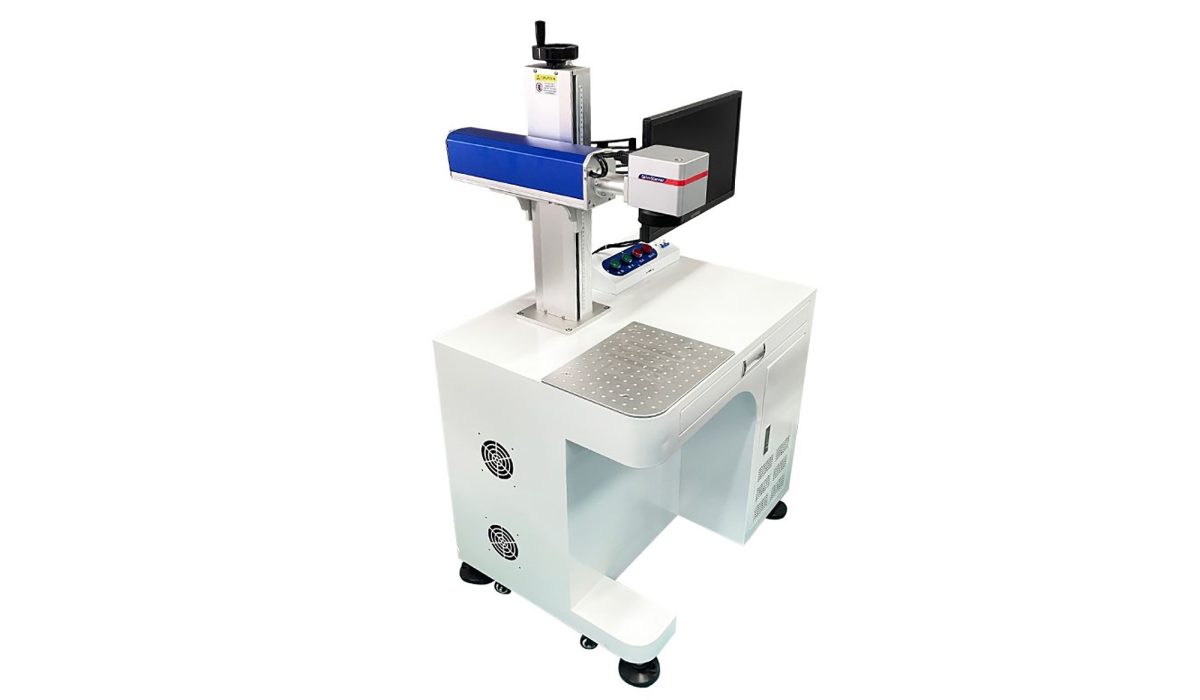
A specification sheet is where good purchases are won and lost. Two units can both be sold as a 100W fiber laser marking machine and still differ by a factor of three in output. Therefore, this guide explains every 100W fiber laser marking machine specifications line item in plain language.
How a 100W Fiber Laser Marking Machine Works
A fiber laser uses a rare-earth-doped optical fiber as the gain medium. Pump diodes excite the fiber, and the output is a 1064 nm beam sent to a galvanometer scanner. Because the beam travels through fiber, there are no mirrors to realign and no lamps to replace. That design is why a 100W fiber laser marking machine stays maintenance-free for most of its life. For background on the process, see laser marking.
Core 100W Fiber Laser Marking Machine Specifications Explained
Below are the fields you should demand in writing, because each one changes your output.
– A short 100W fiber laser marking machine specifications sheet is not a problem. However, a sheet with no model numbers is a serious warning sign.
Choosing the right laser source configuration and Wavelength
The source sets the ceiling for everything else. Therefore, look for the exact model, not just the brand. Common sources in this class include Raycus, JPT and MAX, with IPG at the premium end. The centre wavelength is usually 1050-1070 nm, which metals absorb well.
Average Power, Peak Power and Pulse Energy
Average power of 100W decides marking speed. In addition, peak power and single-pulse energy decide how deep each shot cuts. A modern module can exceed 10 kW of peak power with more than 1 mJ per pulse.
Pulse Width and Frequency
Pulse width in this class ranges from about 2 ns to 500 ns. Frequency ranges from roughly 1.6 kHz to 3000 kHz. Because both can be adjusted, one machine can mark delicate plastics and heavy steel.
Beam Quality (M2)
An M2 between 1.2 and 2.0 is normal for industrial fiber sources. Lower values give a smaller focus spot, so edges look sharper and fine detail holds up better.
Marking Area and Field Lens
The field lens sets the working area. Standard sizes are 70 x 70 mm, 110 x 110 mm, 175 x 175 mm and 300 x 300 mm. A smaller lens concentrates more energy, while a larger one covers more area at lower power density.
Galvo Scanner Speed
High-speed marking accuracy Scanning speed is usually quoted at 7000-12000 mm/s. However, real throughput depends on the graphic, so treat the headline figure as a ceiling rather than a promise.
Cooling
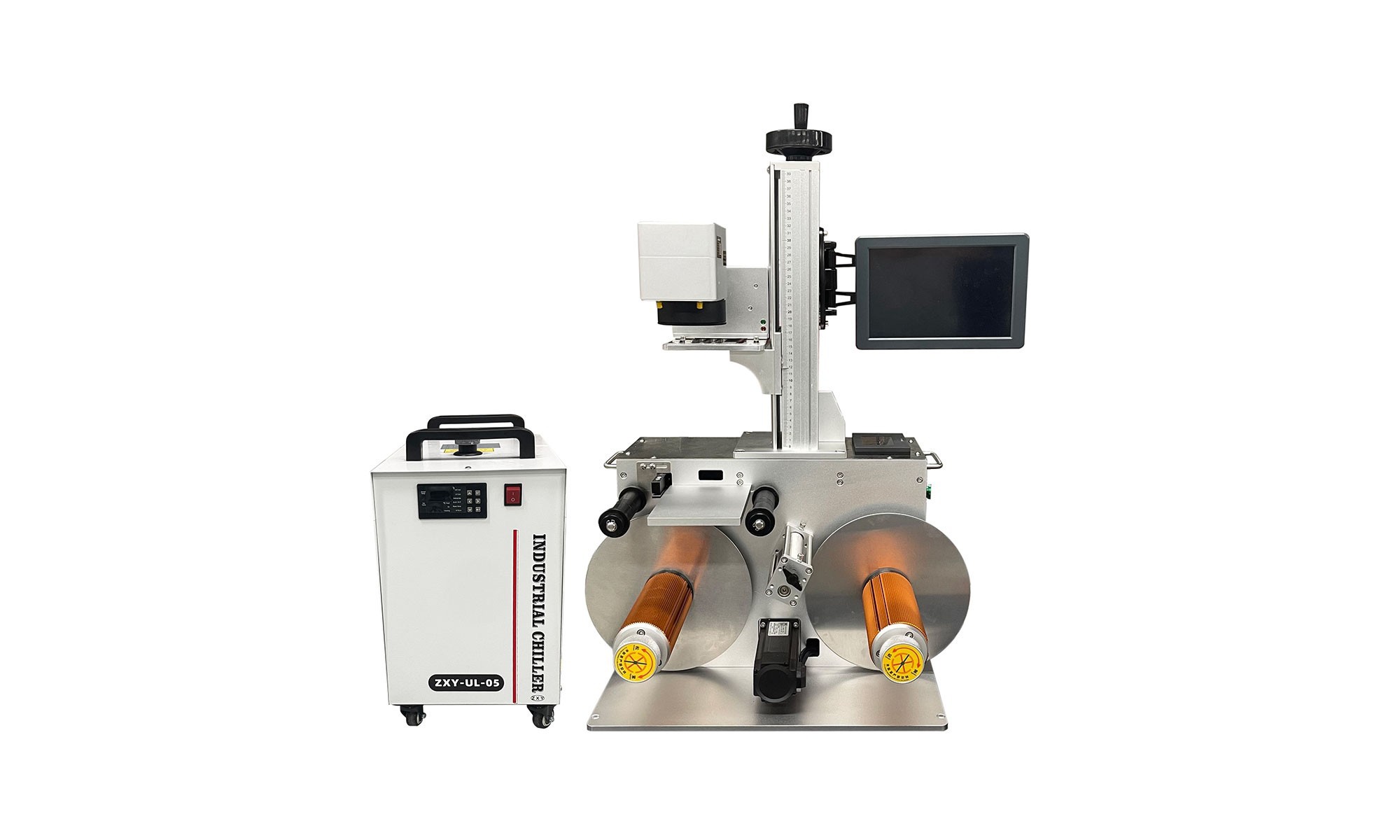
Most 100W fiber laser marking machine heads are water-cooled with an external chiller. As a result, output stays stable across full shifts. Confirm that the chiller is included, not optional.
Control, Software and Interfaces
Almost every industrial unit runs EZCAD or LightBurn. Check that the controller imports AI, DXF, PLT, BMP and JPG files, handles variable data such as serial numbers, and offers RS232 or Ethernet for line integration.
Pulse Width and the MOPA Advantage
Q-switched sources link pulse width and frequency together. MOPA sources separate them, which enables black marking on stainless steel, colour ultra-fine marking on heat-sensitive materials and cleaner marks on anodized aluminium. If colour or high-contrast marking is on your roadmap, specify MOPA now rather than replacing the source later.
Matching the Field Lens to Your Parts
- 70 x 70 mm: fine detail on small parts such as jewellery and connectors.
- 110 x 110 mm: the most versatile general-purpose lens.
- 175 x 175 mm: medium parts and multi-up fixtures.
- 300 x 300 mm and larger: plates, moulds and panels, usually with 3D dynamic focusing.
Speed, Accuracy and Repeatability
Repeat positioning accuracy of about plus or minus 0.01 mm is standard in this class. The 100W fiber laser marking machine specifications should quote this figure, not a marketing estimate.
Safety Classification and Compliance
A 100W fiber laser marking machine is normally a Class 4 laser product. Therefore, plan for the following items.
- A physical enclosure or an interlocked safety cover for unattended work.
- Laser safety eyewear rated for 1064 nm.
- Warning signage and a controlled access area.
- CE or equivalent certification documents.
Installation Environment
- Ambient temperature of 0-40 degrees Celsius, with a stable supply.
- Clean, dry compressed air if the head is air-assisted.
- A level bench or fixture that can carry the head and a rotary axis.
- For water-cooled units, distilled water and a ventilated chiller location.
Parameter Starting Points by Material
| Material | Power share | Notes |
| Stainless steel | 60-90% | Adjust for black versus engraved finish |
| Aluminium | 50-80% | Lower power reduces over-burn |
| Copper and brass | 60-90% | Higher reflectivity needs care |
| Titanium | 50-80% | Excellent contrast |
| Plated metal | 40-70% | Tuned to strip only the coating |
| ABS and PC plastics | 20-40% | Low power avoids melting |
These are starting points only, and the 100W fiber laser marking machine specifications should confirm the safe range for each material. Therefore, always run a small test matrix on your own parts before production.
Maintenance Schedule,trained technical support and warranty service
- Daily: check the lens for dust and inspect the fixture.
- Weekly: verify chiller water level and temperature stability.
- Monthly: clean the field lens with approved wipes.
- Annually: have the optical path and galvo calibrated by a technician.
Good 100W fiber laser marking machine specifications also list the recommended service intervals, so follow them rather than a fixed calendar.
Frequently Asked Questions
What is the difference between 100W and 100W MOPA?
Both deliver 100W of average power. However, a MOPA source adds independent pulse control, which enables colour and high-contrast marking. A fixed-pulse source cannot produce those effects.
Can the marking area be changed later?
Yes. The field lens, and sometimes the galvo, can be swapped to change the working area. Therefore, confirm lens availability when you buy.
Does the machine need a dedicated PC?
Most controllers run standalone. However, a PC is usually used for artwork preparation and job storage. Industrial PCs are common for line integration.
Final Thoughts
Every 100W fiber laser marking machine specifications sheet should be read with three questions in mind. First, which laser source is fitted. Second, which optics are used. Third, what happens when something fails. If you answer those, the rest of the numbers fall into place. Our engineers at FLS Laser will walk your team through a full specification review before you commit.