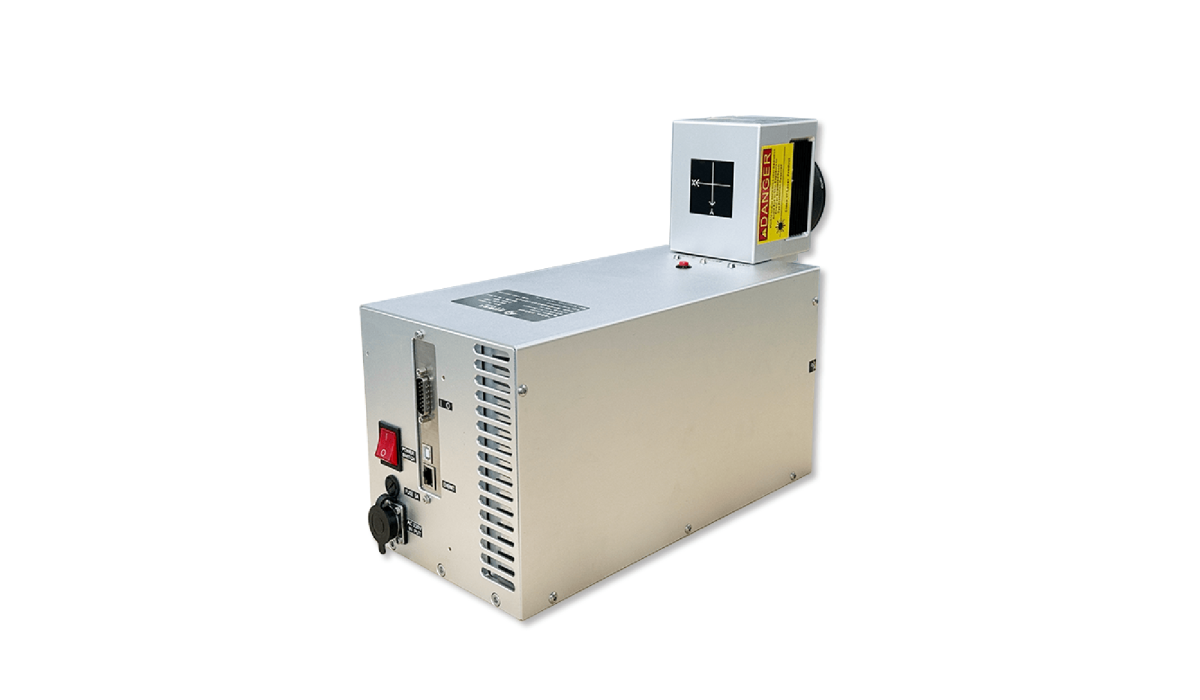
Engineers, production managers, and service technicians evaluating a new handheld laser platform need more than a brochure — they need numbers. In this technical article we break down the 500A laser machine at the subsystem level, covering its laser source, beam delivery, cooling architecture, control logic, and measured performance across thickness, speed, and duty cycle tests conducted in the FLS Laser applications lab in 2026.
The 500A laser machine technical specifications covered here apply to the standard air-cooled 1500W configuration (part number FLS-500A-1500). Where performance differs between 1200W and 2000W factory options, we note the variance explicitly.
1. Laser Source: Raycus/MAX 1500W Continuous-Wave Fiber Resonator
At the heart of the 500A laser machine is a single-module ytterbium-doped fiber laser resonator rated at 1500W continuous output at 1080 nm wavelength. Two configurations are offered as standard:
| Parameter | Raycus RFL-1500S | MAX MFSC-1500X |
|---|---|---|
| Center wavelength | 1080 ± 5 nm | 1080 ± 5 nm |
| Rated output power | 1500W | 1500W |
| Power adjustment range | 10-100% | 10-100% |
| Beam quality M² | < 1.6 | < 1.5 |
| Output fiber core diameter | 50 µm | 50 µm |
| Modulation frequency | 5 kHz | 5 kHz |
| Rated lifetime | 100,000 hours | 100,000 hours |
| Operating voltage | 220V 1φ / 380V 3φ | 220V 1φ / 380V 3φ |
| Efficiency (wall-plug) | > 38% | > 40% |
The 500A laser machine uses a QBH-compatible output connector, so either laser source can be field-swapped in under 30 minutes by a trained technician without returning the unit to the factory.
2. Optical Path and Beam Delivery
From the resonator, the laser travels through a 10-meter armored fiber cable (bend radius ≥ 200 mm) to the handheld processing head. The 500A laser machine uses a shared collimator assembly across all three heads, with quick-release bayonet mounts that swap between welding, cutting, and cleaning heads without realignment.
- Collimating focal length: 50 mm
- Focusing focal length (welding): 150 mm (F150), producing a ~0.2 mm focal spot
- Focusing focal length (cutting): 100 mm (F100), producing a ~0.13 mm focal spot
- Focusing focal length (cleaning): 300 mm (F300), producing a 0.8-3.0 mm adjustable line spot
- Protective lens: D20×F2 quartz, replacement interval 200-400 hours depending on splash load
All heads include nozzle-connect dry air purge to prevent fume deposition on the protective lens.
3. Wobble Welding Head: Dual-Axis Galvo Mechanism
The signature feature of the 500A laser machine is its dual-axis wobble welding head, which oscillates the beam in a controlled circular, linear, or figure-8 pattern at up to 300 Hz. This gives two engineering benefits: (1) it widens the weld bead to 0.5-5.0 mm for better gap tolerance, and (2) it stirs the weld pool to reduce porosity, especially on aluminum and galvanized steel.
- Oscillation modes: Circle, line, triangle, figure-8, infinity
- Oscillation amplitude: 0.1-5.0 mm (software-adjustable)
- Oscillation frequency: 1-300 Hz
- Wire feed rate: 0-8 m/min, auto-synced to travel speed
- Wire diameter: 0.8 mm / 1.0 mm / 1.2 mm / 1.6 mm (auto-detected)
- Nozzle standoff: 2-6 mm (capacitive height sensing, auto-follow)
The head includes a built-in red diode pointer (650 nm, 5 mW) for visual alignment before firing.
4. Integrated Air-Cooling System (No External Chiller)
The most frequent technical question we receive about the 500A laser machine is how a 1500W fiber laser can be air-cooled without sacrificing duty cycle. The answer is a three-stage thermal architecture:
- Source-level heat pipe stack: Aluminum vapor chamber bonded directly to the laser diode bars, with a ducted 350 CFM radial fan pushing ambient air across the fins.
- Head-level micro-channel: Copper heat exchanger in the welding/cutting head, fed by an internal closed-loop liquid circuit that itself is air-cooled by a second fan (the user never sees or services this loop).
- Cabin-level positive pressure: Filtered intake at the bottom of the cabinet, exhaust out the top, with a G4 pre-filter and activated carbon after-filter to keep optics clean in dusty shops.
At 30 °C ambient, the 500A laser machine holds 100% duty cycle at 1200W continuous and 70% duty cycle at 1500W continuous. Above 35 °C ambient, output power is automatically throttled by 10-15% to protect the diodes, which is a conservative safety margin that extends source life.
5. Electrical System and Power Compatibility
The 500A laser machine is built for global deployment without step-down transformers:
- Input voltage: 208-240V single-phase 50/60 Hz or 380-415V three-phase 50/60 Hz (auto-detect)
- Maximum input current: 32A at 220V 1φ / 16A at 380V 3φ
- Rated power consumption: 5.5 kW peak, ~3.2 kW average during continuous welding
- Power factor: > 0.95 with active PFC
- Surge protection: Class B+C combined SPD (20 kA 8/20 µs) on mains input
- EMC compliance: EN 61000-6-2 / EN 61000-6-4 (industrial)
The onboard control PSU provides isolated 24V DC for the wire feeder, sensors, and touch I/O, eliminating ground-loop noise that has historically caused EMC failures on imported laser welders.
6. Control System and Software Stack
The 500A laser machine ships with an industrial 10.1-inch capacitive touch HMI running a real-time Linux controller. The software stack is organized into four layers:
- Preset library: 74 factory-tested recipes covering common material/thickness/gas combinations. Operators can select “2 mm stainless butt weld with 0.8 mm 308 wire” and the machine auto-sets power, wobble, speed, and wire feed.
- Manual tuning: All parameters (power, frequency, duty, wobble shape, amplitude, gas pre/post flow) are exposed to the operator and can be saved to user presets (up to 200 custom slots).
- Diagnostics: Real-time monitoring of laser output power (internal photodiode), head temperature, cabinet temperature, gas pressure, wire feed encoder, and emergency stop chain. All faults are logged with timestamp and sensor values for service traceability.
- Remote support: Optional Ethernet/Wi-Fi module allows FLS engineers to remote-dial the HMI for troubleshooting and firmware updates over an encrypted TLS 1.3 tunnel.
7. Measured Performance Benchmarks (FLS Lab, August 2026)
All benchmarks below were measured on a production-calibrated 500A laser machine with F150 welding head, 1.2 mm ER308 wire where applicable, and 99.99% argon at 12 L/min.
| Material | Thickness | Joint Type | Power (W) | Travel Speed (cm/min) | Weld Strength |
|---|---|---|---|---|---|
| Carbon steel Q235 | 1 mm | Butt | 700 | 220 | Parent metal fracture |
| Carbon steel Q235 | 3 mm | Butt | 1100 | 90 | Parent metal fracture |
| Carbon steel Q235 | 5 mm | Butt (bevel 30°) | 1450 | 50 | > 420 MPa tensile |
| Stainless 304 | 1 mm | Butt | 600 | 200 | Parent metal fracture |
| Stainless 304 | 3 mm | Butt | 1000 | 80 | Parent metal fracture |
| Aluminum 5052 | 2 mm | Butt | 1300 | 110 | > 190 MPa tensile |
| Aluminum 6061 | 3 mm | Fillet | 1400 | 70 | > 170 MPa tensile |
| Galvanized steel | 1.2 mm | Lap | 800 | 180 | Spatter-free at 200 Hz wobble |
| Copper T2 | 1.5 mm | Butt | 1500 (pulsed) | 45 | > 200 MPa tensile |
| Brass H62 | 2 mm | Butt | 1500 | 55 | > 240 MPa tensile |
Cutting performance (F100 cutting head, dry compressed air at 0.8 MPa):
- Carbon steel: 0.5-4 mm at 60-360 cm/min
- Stainless steel: 0.5-3 mm at 50-300 cm/min
- Aluminum: 0.5-2 mm at 40-180 cm/min
Cleaning performance (F300 cleaning head, 1500W, 200 mm/s):
- Surface rust removal: up to 20 m2/h
- Paint strip (100 µm epoxy): up to 12 m2/h
- Weld oxide/pattern removal: up to 25 m2/h
8. Mechanical Dimensions and Installation Requirements
| Parameter | Value |
|---|---|
| Cabinet dimensions (W × D × H) | 780 × 460 × 830 mm |
| Net weight | 128 kg |
| Gross shipping weight (crate) | 175 kg |
| Handheld head weight | 0.95 kg |
| Fiber cable length | Standard 10 m, optional 15 m |
| Operating temperature | 5-40 °C |
| Operating humidity | 10-85% RH non-condensing |
| Compressed air (cleaning/cutting) | 0.6-1.0 MPa, dry, filtered |
| Shielding gas (welding) | Argon or Ar-N2 mix, 10-15 L/min |
Installation requires a 220V 32A or 380V 16A dedicated circuit, a level floor (gradient ≤ 3°), and at least 1 meter clearance on the fan exhaust side. No special foundation or water chiller is required.
9. Safety and Compliance Engineering
The 500A laser machine is classified as a Class 4 laser product per IEC 60825-1 during operation. Safety systems engineered into every unit include:
- Dual-channel emergency stop loop (controller + contactor)
- Interlocked cabinet door switches (source cannot fire when cabinet is open)
- Handheld head trigger with two-stage enable (light press = preview, full press = fire)
- Welding nozzle contact detection (no close contact = no fire)
- Over-temperature, over-current, and back-reflection protection for the source
- Included CE-certified laser safety goggles (OD7+ @ 1060-1090 nm) for operator and bystander
The machine is CE-marked (Machinery Directive 2006/42/EC, EMC Directive 2014/30/EU, RoHS 2011/65/EU), FDA CDRH-laser-compliant for US import, and manufactured under ISO 9001:2015 quality management.
10. Serviceability and Field Repair Design
Unlike many imported laser welders that require a technician to fly in for every fault, the 500A laser machine is designed for field service:
- Source swap: QBH connector + 6 DC bolts; replaceable in 30 minutes.
- Protective lens: Tool-less drawer on the head; 30-second swap.
- Wire feeder motor: 4-screw drawer replacement; no calibration needed.
- Control board: Modular PCBA with labeled connectors; board-level replacement in 15 minutes.
- Firmware: USB-stick update or OTA over the remote support module.
FLS Laser publishes a full service manual (password-protected for trained technicians) and stocks spare parts in Shenzhen, Los Angeles, and Hamburg warehouses for next-business-day dispatch.
Frequently Asked Technical Questions
Q: Can the 500A laser machine weld copper and brass without back-reflection damage?A: Yes. The Raycus/MAX sources used in the 500A laser machine include a built-in back-reflection isolator (> 35 dB isolation), and the cutting/welding heads have an angled protective window (7° wedge) to further reduce direct retro-reflection. We have run 1.5 mm copper T2 butt welds for 8 continuous hours in lab testing without source protection trips.
Q: What is the actual focal spot size on the workpiece?A: With the F150 welding head and 50 µm fiber, the theoretical focal spot is ~0.2 mm (1/e²). Real-world measurements with a BeamWatch camera show 0.22-0.25 mm at optimal standoff, which is consistent across all production units.
Q: Does the 500A laser machine support automation or robotic integration?A: Yes. The controller exposes a 24V opto-isolated I/O bank (8 in / 8 out), an Ethernet/IP option, and 0-10V analog power control, so the 500A laser machine can be mounted to a 6-axis robot, gantry, or custom CNC table using an available mounting adapter kit.
Q: What is the recommended ambient temperature for full power?A: The 500A laser machine delivers full 1500W output at ambient temperatures of 5-30 °C. At 30-35 °C it remains at full power but fan noise increases slightly; above 35 °C an automatic 10% power throttle engages to protect diode life.
Further Technical Reading
For engineers integrating the 500A laser machine into a production line, the companion support guide covers setup, warranty, maintenance, and field troubleshooting, and the product overview describes shop-floor use cases and standard package contents.The full CAD step file and 3D mounting drawing are available on request from FLS Laser engineering support.